Psychology of Career Stagnation vs Finding Meaning

Many people spend years working toward success. They pursue promotions, salary increases, recognition, leadership positions, and professional achievements. From the outside, it may appear that they have everything they set out to accomplish. Yet beneath the surface, a different experience often emerges.
Despite career success, some individuals report feeling exhausted, disconnected, unmotivated, or emotionally flat. They may wake up each morning with a sense of dread, question the purpose behind their work, or wonder why achieving their goals has not brought the fulfilment they expected. If this sounds familiar, you are not alone.
At AO Psychology, we frequently encounter individuals who are not struggling because they lack success—but because success alone is not enough to create a meaningful life. The question is not simply: “Am I successful?” …But rather: “Am I living in alignment with what truly matters to me?”
The Hidden Cost of Modern Success
Modern society often teaches us that happiness is the natural outcome of achievement.
The formula seems straightforward:
- Work hard
- Achieve more
- Earn more
- Gain recognition
- Feel fulfilled
Unfortunately, human psychology is far more complex. Research consistently shows that while achievement can create temporary satisfaction, its emotional impact tends to fade relatively quickly. What initially feels exciting soon becomes the new normal, leading many people to chase the next milestone. This phenomenon is often referred to as the hedonic treadmill—the tendency for people to adapt to positive changes and return to their baseline level of happiness.
As a result, many professionals find themselves trapped in an endless cycle:
Achieve → Feel good briefly → Adapt → Want more → Repeat
Without deeper sources of meaning, success can become an exhausting pursuit rather than a fulfilling one.
Why We Get Stuck
One of the most useful frameworks for understanding this experience comes from Polyvagal Theory, developed by Stephen Porges. Polyvagal Theory suggests that our nervous system continuously evaluates whether we are safe or threatened. Depending on our state, our capacity to think clearly, connect with others, and access meaning changes significantly.
Ventral Vagal State: Safe and Connected
When we feel safe, our nervous system supports (1) Creativity, (2) Connection, (3) Curiosity, (4) Problem-solving, (5) Purpose-driven behaviour. In this state, meaning becomes accessible.
Sympathetic State: Fight or Flight
When stress levels rise, the body shifts into mobilisation mode. We may experience (1) Anxiety, (2) Restlessness, (3) Overworking, (4) Perfectionism, (5) Hypervigilance. Many high-achieving professionals unknowingly spend extended periods operating in this state.
Dorsal Vagal State: Shut Down
When stress becomes overwhelming, some individuals move into a state of shutdown. This may look like (1) Emotional numbness, (2) Disconnection, (3) Exhaustion, (4) Burnout, (5) Loss of motivation. In these states, finding meaning becomes increasingly difficult because the nervous system is focused on survival rather than growth.
Meaning is not simply a mindset. It is also a physiological experience.
Meaning Is Created, Not Found
Many people search for meaning as though it is something waiting to be discovered. However, psychological research increasingly suggests that meaning is not something we stumble upon. It is something we actively create. One evidence-based approach that supports this understanding is Acceptance and Commitment Therapy (ACT).
ACT teaches that psychological well-being does not come from eliminating difficult thoughts or emotions. Instead, it comes from developing psychological flexibility—the ability to stay present and take meaningful action even when life is challenging. This shift changes the question from:
“How do I feel better?” to…
“How do I live well?” … even when stress, uncertainty, or discomfort are present.
Goals Versus Values: An Important Difference
One of the most powerful ideas in ACT is the distinction between goals and values.
Goals Are Destinations
Goals have endpoints. Once achieved, they are complete. Examples include:
- Getting promoted
- Buying a home
- Reaching a salary target
- Completing a degree
Values Are Directions
Values represent the qualities we want to embody throughout our lives. Examples include:
- Compassion
- Growth
- Integrity
- Connection
- Curiosity
- Contribution
Unlike goals, values never end. You cannot finish being compassionate. You cannot complete integrity. You simply continue living them. This distinction matters because many people build their lives entirely around goals while neglecting values. When the goal is achieved, they are left wondering “What now?”
Values provide ongoing direction regardless of circumstances. They create a stable foundation that continues to guide us long after specific achievements have been reached.
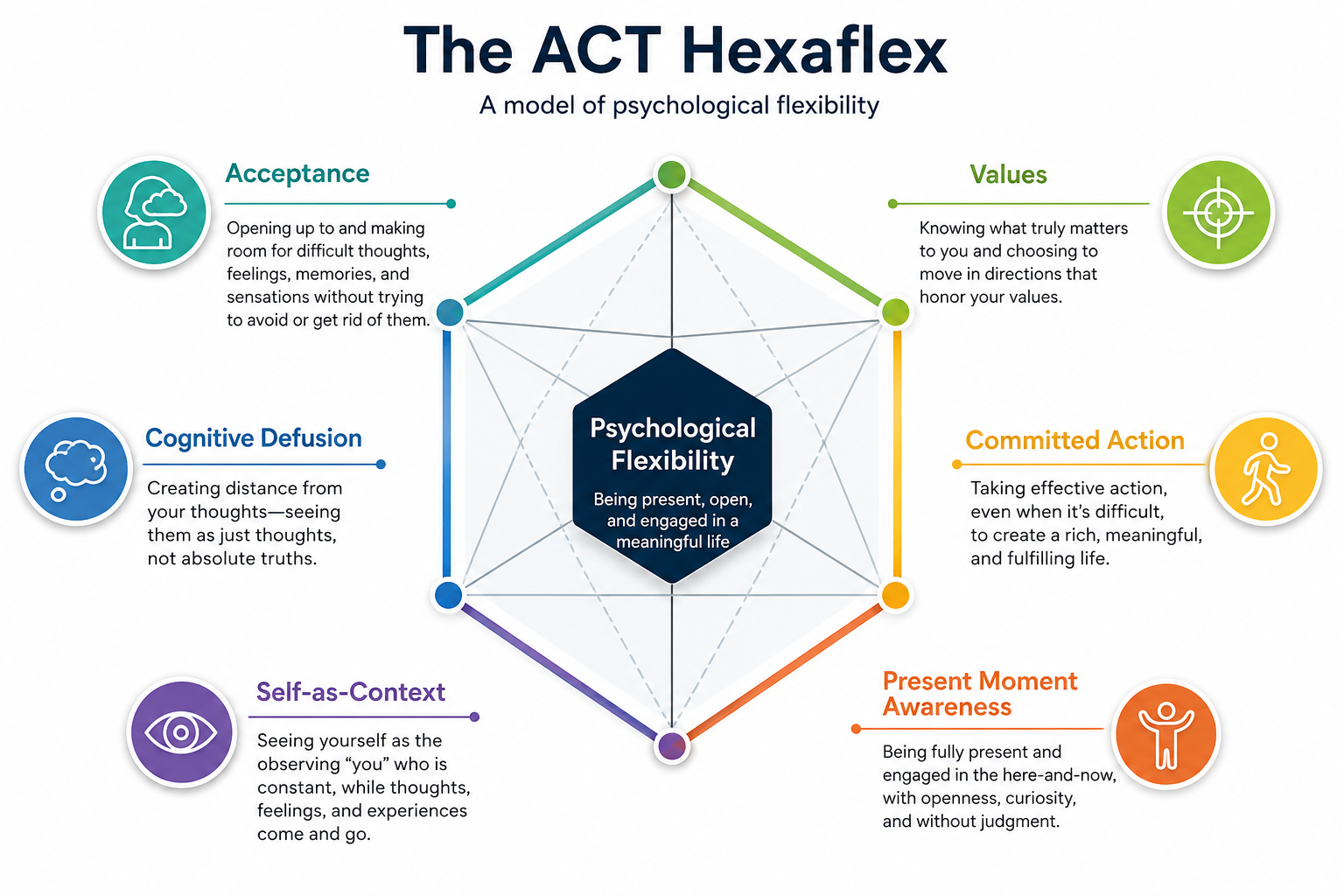
The ACT Hexaflex: Six Pathways to a Meaningful Life
Acceptance and Commitment Therapy (ACT) identifies six core processes that help individuals develop psychological flexibility.
1. Acceptance: Learning to make room for difficult emotions rather than fighting them.
2. Cognitive Defusion: Recognising that thoughts are not always facts. Just because you think something does not mean it is true.
3. Being Present: Developing awareness of what is happening right now.
4. Self-as-Context: Seeing yourself as more than your thoughts, emotions, or circumstances.
5. Values: Clarifying what genuinely matters to you.
6. Committed Action: Taking consistent steps toward your values.
Together, these processes support a life that feels meaningful rather than merely productive.
Small Actions Create Big Change
One common misconception is that meaningful transformation requires dramatic life changes.
In reality, lasting change is often built through small, repeated actions.
Consider the difference between:
- Spending one day exercising intensely
- Exercising moderately several times per week
The second approach typically produces better long-term outcomes. The same principle applies psychologically.
Meaning is often built through small choices:
- Having an honest conversation
- Setting a healthy boundary
- Taking a short mindful pause
- Choosing rest when needed
- Acting in alignment with personal values
These seemingly minor actions compound over time. A meaningful life is rarely created through one grand decision. It is built one choice at a time.
Bringing Mind, Body and Emotions Together
Many approaches to well-being focus on only one aspect of human functioning. Some focus exclusively on thoughts. Others focus only on physical health (via somatic therapy and yoga therapy). Still others focus solely on emotions (via holistic nutrition). At AO Psychology, we believe meaningful and sustainable well-being emerges when the mind, body, and emotions work together. This integrated perspective recognises that:
- Thoughts influence emotions
- Emotions influence the body
- The body influences thoughts
- All three shape our sense of purpose and fulfilment
When these systems become aligned, individuals often experience:
- Greater self-awareness
- Stronger emotional resilience
- Improved relationships
- Better decision-making
- Increased sense of purpose
Coming Home to Yourself
Perhaps the greatest misconception about fulfilment is the belief that it exists somewhere in the future.
Many people tell themselves, “I’ll be happy when…”
- I get promoted.
- I earn more.
- I retire.
- life becomes easier.
But meaningful living rarely begins in the future. It begins with learning to reconnect with yourself in the present. It begins with listening to your body. Clarifying your values. Regulating your emotions. Taking small actions that reflect what truly matters.
Because meaning is not something we find at the end of a journey. It emerges when our mind, body, and emotions move in the same direction. And when they do, we often discover that fulfilment was never about achieving more. It was about coming home to ourselves.

How AO Psychology Can Help
Feeling stuck at work is rarely just a career problem. It often involves deeper questions about identity, values, purpose, stress, and emotional wellbeing. At AO Psychology, we understand that career fulfilment is not simply about productivity or performance. It is about understanding what matters to you and creating greater alignment between your inner world and your daily life. Through psychotherapy, counselling, and our holistic approach to mental wellness, we help individuals:
- Explore personal values and purpose
- Understand patterns of stress and burnout
- Navigate career transitions and uncertainty
- Reconnect with motivation and meaning
- Develop greater self-awareness and emotional clarity
The goal is not necessarily to change jobs. The goal is to understand yourself more deeply so that your choices become intentional, aligned, and meaningful.
Take the First Step
👉 Contact AO Psychology to schedule a confidential consultation and begin the process of understanding your emotions, making wiser decisions, and moving forward with greater balance and peace.